What Am I Looking At? The Mechanics of Perception
When a viewer stands before a photograph, their brain instinctively seeks to categorise the visual data. We tend to assume the camera is a passive mirror, providing a neutral, objective record. This is the fundamental fallacy of photography. The lens is an instrument of rigorous, active translation. Whether presenting a straightforward, uncompromising document of a subject, or deliberately stripping away its context to force a new, abstract interpretation, the camera never merely captures reality - it dictates perception.
This essay explores the psychological and mechanical architecture of sight, revealing how the deliberate manipulation of optics, time, and framing bypasses the biological eye to engineer exactly how we experience the world.
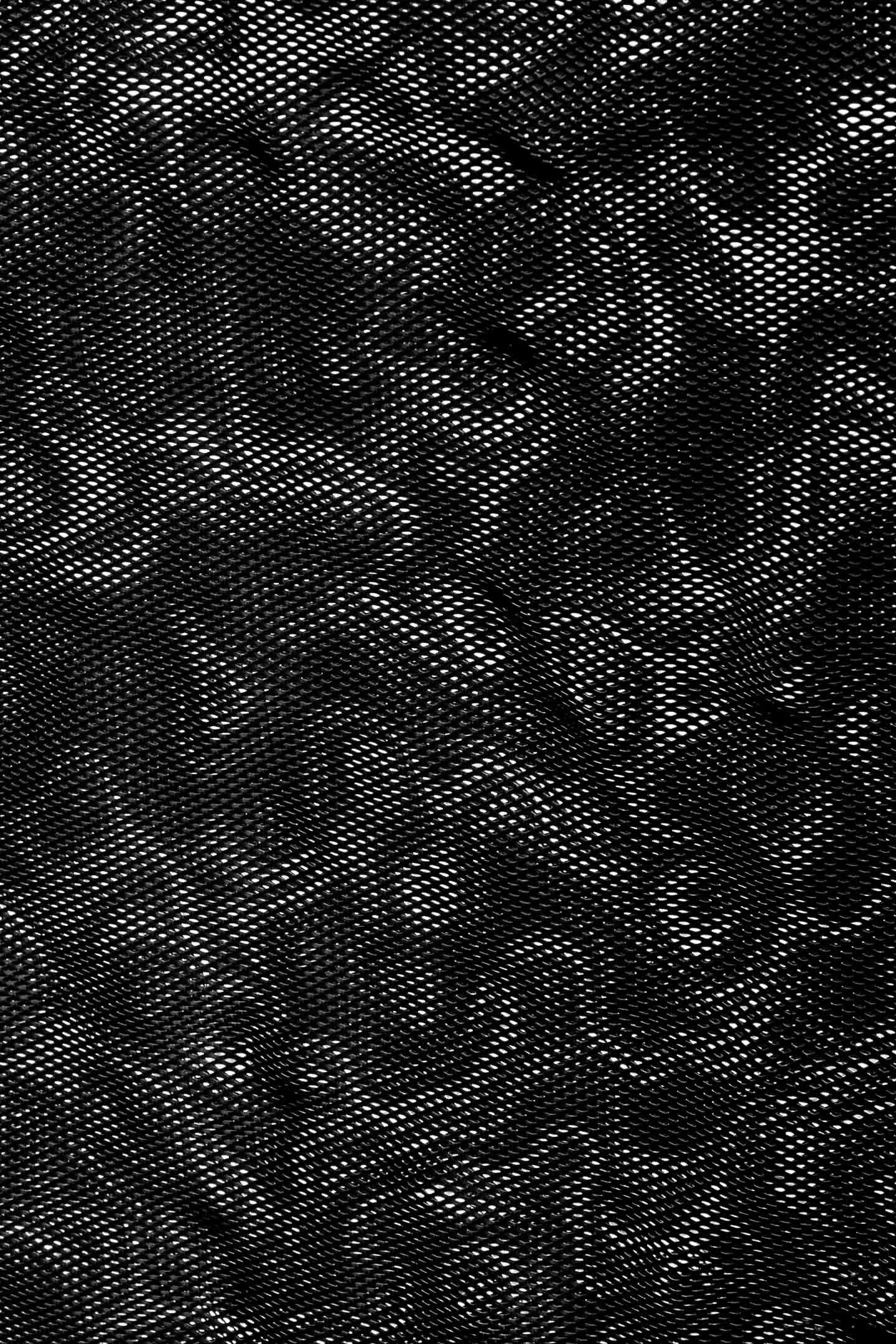
The dictatorship of focus: Herzog & de Meuron’s Schaulager facade, isolated into pure rhythm and material tension.
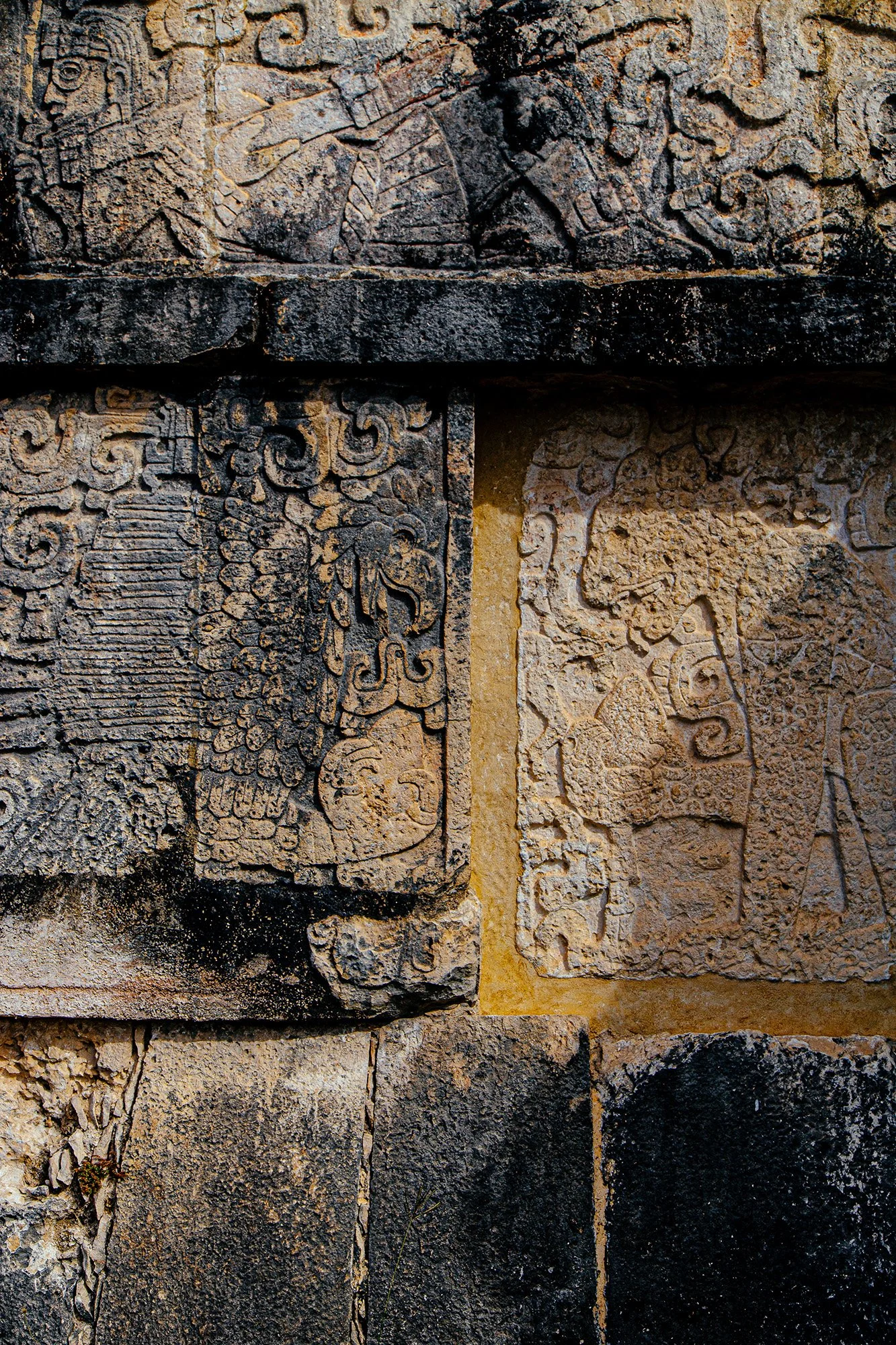
Maya stone relief, Chichen Itza. The lens extracts a fragment of the historical record, reducing the monument to pure structural geometry.
The Mechanics of Perception
When we occupy a physical space, we tend to assume that a photograph of that environment will yield a straightforward, objective truth. The camera, however, is not a mirror; it is an instrument of rigorous, active translation.
In his seminal work Ways of Seeing, the critic John Berger established that every image embodies a specific way of seeing. He noted that whenever we look at a photograph, we are aware, however slightly, of the photographer selecting that specific sight from an infinity of other possible sights.[^1] This act of selection is a mechanism of design. In his treatise on the subject, Alan Moore argues that true beauty is never a superficial afterthought; rather, it is a foundational force that brings order to chaos, fulfilling a deep-seated human requirement for harmony.[^2]
"The camera never merely captures reality—it dictates perception."
To accept these premises is to understand that a photograph is never a passive record. Compressing a living environment into a flat, two-dimensional plane, and isolating a fraction of a second from the flow of time, decisively untethers the subject from its physical context. What remains is a highly engineered translation. Mastering the underlying mechanics of that illusion - and utilising them to guide the viewer's interpretation with absolute intention - forms the true discipline of the photographic art.
The Spectrum of Intent: The Literal and the Abstract
To guide cognitive response, the photographer must first decide how they want the viewer to see. This decision operates on a spectrum between the straightforward document and the deliberate abstraction.
There are instances where the technique must be uncompromisingly literal. In these moments, the goal is absolute clarity. The photographer uses depth of field and precise lighting to establish an undeniable record of a subject or a space - a chef plating a dish, the geometry of architecture, the candid interaction between two people. The subject is obvious, but the chaos of reality has been meticulously ordered within the frame to satisfy the brain's demand for structure.
Conversely, the photographer can use the same mechanics to deliberately obscure the subject. By moving in close and cropping out contextual anchors, the lens strips a familiar object of its domestic associations. Fish scales or mushroom ridges cease to register as food and is transformed into a geographical terrain. Both approaches - the straightforward and the abstract - are deliberate visual translations. In both cases, the photographer remains firmly in control of the cognitive outcome.
The Biological Eye vs. The Mechanical Lens
To master this translation, one must understand how we actually see. The human eye does not operate like a camera. It is a restless, organic mechanism. As we navigate a room, our gaze darts continuously, absorbing peripheral data, shifting focus from foreground to background, and adjusting to extreme variances in light and shadow in real time. The brain processes this fragmented stream and builds a seamless, composite understanding of the environment.
The camera executes none of these biological functions. It operates within a rigid boundary, capturing a single focal plane and a single exposure value. Rather than viewing this as a limitation, the art of photography utilises it as a psychological tool. The neuroscientist Semir Zeki has demonstrated that the visual cortex is hardwired to seek out specific cues—such as stark contrast, intersecting lines, and structural grouping—to efficiently parse and navigate the physical world.[^3]
"The lens distils spatial clutter into the precise geometry the brain naturally craves."
Because the camera filters the relentless flood of information that the biological eye usually absorbs, it provides the exact framework needed to isolate and exaggerate these cues. Through the manipulation of light and framing, the lens distils spatial clutter into the precise geometry the brain naturally craves. The photograph, therefore, does not mimic human sight; it bypasses the environment's natural distractions to hyper-stimulate the neural pathways.
The Isolation of Time
Our biological experience of time is a continuous, uninterrupted flow. We do not experience life in fractions of a second; we experience motion, momentum, and consequence. The camera, however, possesses the unique mechanical ability to cleanly extract a single micro-second from the timeline.
The manipulation of the shutter is a deliberate calibration of time, authoring a specific narrative. Halting a fraction of a second can reveal the hidden architecture of a moment—the exact tension in a chef's jaw, the suspension of a pouring liquid, or a micro-expression on a subject's face that flashes and vanishes before the human eye can consciously register it. Alternatively, dragging the shutter into a long exposure compresses minutes of complex movement into a cohesive, flowing shape. The kinetic energy of a busy restaurant service reorganises into structural elegance. In both instances, the resulting image creates a visual reality that never existed for the naked eye.
The Architect of Perception
Recognising that the camera is not a mirror fundamentally shifts the approach to the medium. If scale, time, and space within an image are constructed variables, then photography is primarily a discipline of omission.
"The power of an image lies just as much in what is deliberately cropped out of the frame as what is left inside it."
The power of an image lies just as much in what is deliberately cropped out of the frame as what is left inside it. This rigorous curation aligns with Moore's philosophy that enduring creation requires absolute intentionality—the courage to remove the superfluous until only the essential truth remains.
The photographer functions as the architect of perception. Whether presenting a straightforward, highly ordered document of a kitchen, or isolating the abstracted, psychological weight of a portrait subject against a seamless void, the methodology remains the same. Physical reality requires physical presence to be understood, and it is strictly bound by geography and time. Mastering the visual mechanics of the camera untethers the subject from those limitations. By dictating exactly how the viewer experiences the frame, the photographer engineers a definitive record designed to resonate long after the physical encounter has ended.
[^1] Berger, John. Ways of Seeing. Penguin Books, 1972. [^2] Moore, Alan. Do Design: Why Beauty is Key to Everything. Do Book Company, 2016. [^3] Zeki, Semir. Inner Vision: An Exploration of Art and the Brain. Oxford University Press, 1999.